Pro Tips
Music industry predictions for 2025 in Sync, Promo, and A&R


What will shape the music industry in 2025? Emerging trends point to a future defined by AI-driven talent discovery, immersive world-building, and direct-to-fan platforms empowering artists to connect authentically with their audiences. Sync licensing opportunities are expanding, genre-blending music is thriving, and new technologies are revolutionizing how music is created, marketed, and consumed. Here’s a look at the innovations and strategies set to dominate the music landscape in the year ahead.
Sync licensing trends in 2025

Increased revenue potential
In 2025, sync licensing continues to be one of the most lucrative fields for artists and rights holders, with global revenues estimated to range between $600 and $650 million (IFPI).
As streaming services like Netflix, Disney+, and others become the dominant form of television consumption in the United States (Statista), and the gaming industry continues to be one of the fastest-growing sectors in Entertainment & Media (PWC) , the demand for music to sync with audiovisual projects is set to rise in 2025.
Want to find out how to get your music synced in 2025? Join our next live workshop.
Ditching the “sync friendly” label and prioritizing originality
As we saw in a previous article, the sync licensing industry is getting less picky when it comes to demanding “sync friendly” music from rights holders.
Of course, this is a request you’ll still get from music buyers if you’re actively trying to get your music synced, but there’s a growing tendency for music supervisors to prioritize original and unique tracks, even if they’re unusual.
At the end of the day, their endgame is finding music that will make their audiovisual projects emotionally impactful and memorable, above anything else.
That said, here are a few genres that we can expect to see getting synced in 2025:
Hip-Hop and R&B, especially for content targeting younger audiences watching TV, movies and commercials.
Indie and Alternative Rock, particularly for dramas and indie films.
Electronic genres like House dance, trap and drill music, for energetic and upbeat visual content
Latin Music as the global popularity of Latin music continues to rise.
Retro / Throwback styles, often in demand for projects that seek to evoke nostalgia.
The rise of AI powered tools for sync
As the music industry becomes more and more saturated with content, with around 150,000 songs uploaded per day on streaming platforms in 2025 (estimated from 2023’s statistic), music supervisors will need to start relying on AI music analyzers to sort through these enormous catalogs and intuitively search for sync gems within them.
Bridge.audio is among the leaders in this field through its AI-powered sync marketplace Bridge Sync, but there are several others also paving the way. Read our comparative analysis on the best AI music analyzers for sync licensing to find out which one is best for you.
Music promotion trends in 2025

Direct-to-fan: a move towards owned audiences
In 2025, artists are increasingly gravitating towards direct-to-fan platforms to cultivate owned audiences. These platforms are meeting a growing need expressed by artists to:
- Own their audience data
- Lose their reliance on social media algorithms
- Monetize their work through subscriptions, exclusive content, and personalized interactions
Platforms like Patreon exemplify this trend, offering artists a sustainable income stream and creative autonomy.
This shift comes in the wake of a growing frustration artists are feeling with social media algorithms that tend to only show their posts to a small minority of followers, and streaming platforms that don’t bring in enough revenue per stream.
*“Traditional models that rely heavily on 3rd-party platforms & algorithms are no longer sufficient for artists who want to build resilient & profitable careers,” says Rob Abelow in his Where Music’s Going Newsletter (October 2024).
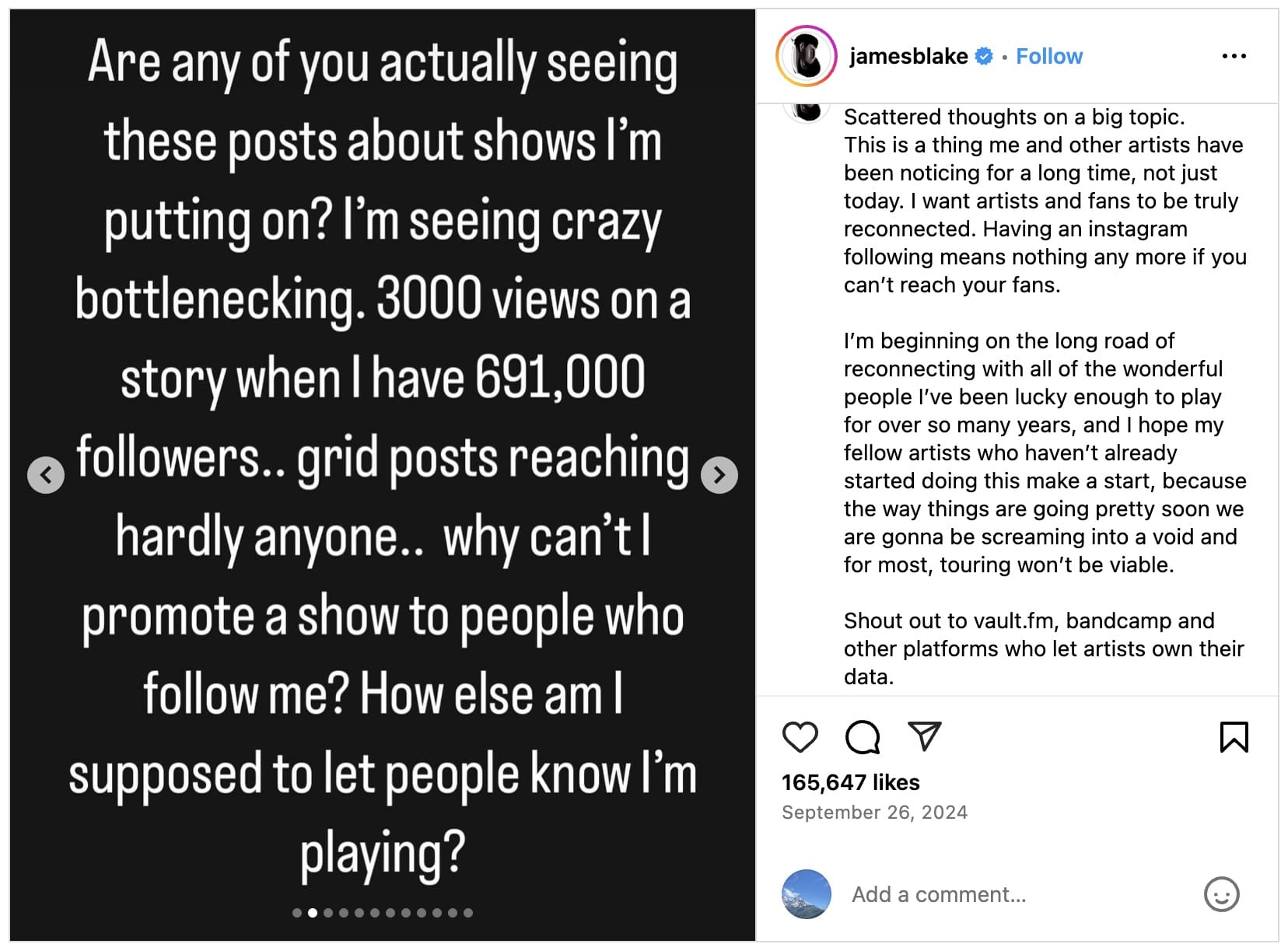
By focusing on direct-to-fan strategies, artists can build dedicated communities, ensuring that their reach and engagement are determined by genuine fan interest rather than the constraints of ever-changing social media algorithms. This approach not only fosters a more authentic artist-fan relationship but also provides a more predictable and equitable revenue model in the evolving music industry landscape.
The rise of AI-driven marketing
AI-driven marketing will continue to transform the music industry in 2025, enabling artists and labels to reach audiences with precision and efficiency.
Tools like Your Music Marketing platform leverage AI to analyze streaming data, social media trends, and audience demographics, allowing artists to create paid media campaigns that target fans that are most likely to engage with their music.
By automating audience segmentation, campaign optimization, and even content creation, AI-driven marketing is making it easier for artists to grow their reach and build lasting fan relationships in an increasingly competitive landscape.
Gamification of Music Discovery & World Building
In 2025, the convergence of the music and video game industries will likely intensify, with artists increasingly engaging in “world-building” to craft immersive, narrative-rich experiences that captivate audiences.
World-building involves creating expansive, cohesive universes that extend beyond music to include visual art, storytelling, and interactive elements, fostering deeper fan engagement.
A notable example is Snoop Dogg’s live concert in Times Square, which was simultaneously broadcast as an in-game event in Fortnite. This collaboration marked a significant integration of music into Fortnite’s metaverse, allowing fans to experience the performance both physically and virtually.
The music industry’s increasing focus on “world-building” responds to a need for deeper fan engagement and loyalty in an era of digital saturation.
As social media and streaming platforms flood the market with content, artists seek innovative ways to stand out and cultivate dedicated fanbases. World-building allows artists to create immersive experiences that extend beyond music, fostering a sense of community and belonging among fans.
A&R (Artists & Repertoire) Trends in 2025
AI in Talent Discovery
In 2025, A&R professionals will increasingly use AI tools to identify and evaluate emerging artists. These AI-powered tools analyze vast amounts of data from streaming platforms, social media, and music blogs to uncover rising talents and predict their potential success. Here are a few examples:
Sodatone, an AI-driven platform acquired by Warner Music Group, which utilizes machine learning algorithms to process data from Spotify playlists, social media engagement, and other online metrics to identify promising artists. This approach allows A&R professionals to make data-driven decisions, reducing reliance on traditional scouting methods.
Instrumental, a UK-based company that employs AI to analyze streaming data and social media trends, providing A&R teams with insights into emerging artists and market dynamics. This enables labels to proactively discover talent that aligns with current and future music trends.
Bridge.audio a music productivity & discoverability platform that enables talent scouts to receive demos and filter their inbox by AI auto-tags such as genre, mood, vocal type, song theme, language, instrumentation and more, thus helping them find rising talent more effectively.
Emphasis on self-sufficient artists
A&R professionals are increasingly prioritizing artists who demonstrate self-sufficiency and maintain direct connections with their audiences through direct-to-fan platforms like Patreon in 2025.
These artists often exhibit a strong, engaged fan base, which is a valuable asset for labels seeking to expand their reach and ensure a dedicated following. Platforms such as Patreon have reported significant growth, with creators surpassing 60 million free memberships and increasing monthly revenue from one-time purchases by four times, indicating a robust and active community around these artists.
Prioritizing innovative, cross-genre music
In 2025, A&R professionals are continuing to favor artists who blend genres and musical cultures, creating innovative sounds that resonate with diverse audiences.
This trend towards genre fluidity reflects a growing global demand for cross-genre experiences, with artists merging elements from various musical styles to craft unique and engaging music.
Here are three notable cross-genre tracks that gained significant attention in 2024:
- “Move” by Adam Port, Stryv, Malachili and Camilla Cabello 55M+ streams on Spotify (as of January 2025)
- “I Had Some Help” by Post Malone and Morgan Wallen 876M+ streams on Spotify (as of January 2025)
- “A Bar Song (Tipsy)” by Shaboozey 1B+ streams on Spotify (as of January 2025)
These songs illustrate the commercial and cultural success of cross-genre experimentation in 2024, setting the stage for more genre-fluid music in 2025.
Conclusion
As the music industry looks ahead to 2025, adaptability and innovation remain at the forefront of success. From the expanding potential of sync licensing to the rise of direct-to-fan platforms and AI-driven tools, artists have new opportunities to connect with audiences and build sustainable careers in a competitive and saturated market. A&R professionals continue to play a pivotal role, combining traditional expertise with data-driven strategies to discover and nurture unique talent. Meanwhile, world-building through video-game collaborations offers artists a powerful way to stand out, foster loyal communities, and create lasting impact in an increasingly crowded field. These trends highlight a future where creativity and technology converge to shape the next chapter of music.